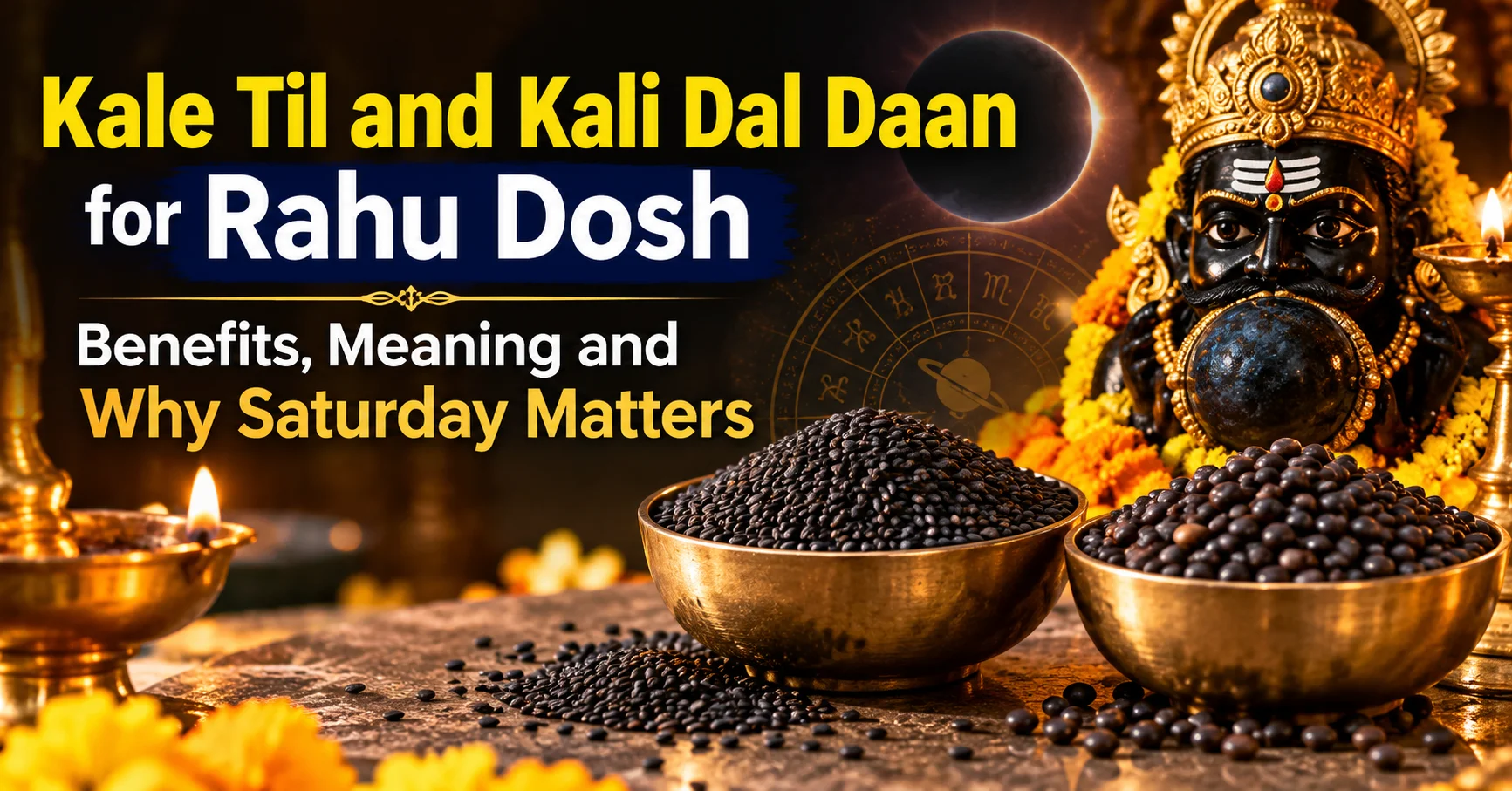
If you have ever consulted an astrologer about unexplained delays, constant confusion or sudden setbacks, you may have heard the word Rahu. One of the most common remedies suggested is simple: donate kale til (black sesame) and kali dal (black urad dal), preferably on a Saturday.
Why these items? Why that day? And what do devotees actually believe they receive from it? This article explains the tradition, the symbolism and the right way to do it, without exaggerated promises.
A note before we begin: everything here is based on Hindu astrological and religious tradition. It is a matter of faith, not a scientific or medical claim, and no result is guaranteed.
Who is Rahu?
Rahu is one of the Navagrahas, the nine planetary influences in Vedic astrology. Unlike the Sun or Moon, Rahu is not a physical planet. It is a chhaya graha, a shadow planet.
According to the Puranic story of Samudra Manthan (the churning of the ocean), the demon Svarbhanu disguised himself as a god and drank a few drops of amrit. The Sun and Moon recognised him and alerted Lord Vishnu, who severed his head. The head became Rahu and the body became Ketu. Because of this, Rahu is said to carry a lasting grudge against the Sun and Moon, which is how eclipses are traditionally explained.
In Paithani, in the Pauri Garhwal district of Uttarakhand, there is a well-known temple dedicated to Rahu. Local tradition connects the place with Rahu, and devotees come here to seek relief from Rahu's influence.
What is Rahu Dosh?
In astrology, Rahu dosh is said to arise when Rahu is placed unfavourably in a person's birth chart, or when someone is going through Rahu Mahadasha or Antardasha. A related condition, Kaal Sarp Dosh, is described when all the planets fall between Rahu and Ketu in the chart.
Traditionally, the following are associated with an afflicted Rahu:
- Mental restlessness, confusion and overthinking
- Repeated obstacles just before success
- Delays in marriage, career or finances
- Sudden ups and downs
- Fear, anxiety or a sense of being stuck without knowing why
Only a qualified astrologer can read your chart. Nobody should assume Rahu dosh from symptoms alone, and these experiences also have ordinary causes that deserve ordinary solutions.
What is Daan and Why Is It Part of Rahu Remedies?
Daan means giving, without expecting anything in return. Hindu tradition places it at the centre of graha shanti. The idea is that each planet is linked to certain materials, colours and days. Offering those materials, with the right intention, is believed to calm that planet's influence.
Daan is also valued for a simpler reason. It reduces attachment, builds humility and helps someone in need. Even if you set astrology aside, giving food to a person who needs it is a good act.
Why Kali Dal (Black Urad Dal)?
In the traditional Navagraha dhanya (grains of the nine planets), urad dal is the grain assigned to Rahu. This is the main reason it is offered in Rahu pujas.
Devotees also see symbolism in it:
- Its dark colour matches Rahu's shadowy, mysterious nature.
- It is a staple food, so the offering feeds someone in real life.
- Urad is considered "heavy" and grounding, which is why it is linked with calming a restless mind.
Why Kale Til (Black Sesame)?
Black sesame is most strongly linked to Shani (Saturn), but it is also widely used in Rahu and Ketu remedies. Traditional texts describe Rahu as behaving much like Saturn, giving slow, testing and karmic results. Because of this overlap, black sesame appears in many Rahu shanti offerings.
Sesame also holds a special place in Hindu ritual. It is used in:
- Pitru tarpan and shraddha rituals
- Havan and fire offerings
- Daan to ward off misfortune
It is considered purifying, and the oil-rich seed is seen as a symbol of removing negativity.
Benefits Devotees Traditionally Believe In
People who offer kale til and kali dal with faith commonly describe these hoped-for benefits:
- Peace of mind: a calmer, less restless state.
- Reduced effects of Rahu dosh: relief during a difficult Rahu dasha.
- Removal of obstacles: smoother progress in work and plans.
- Protection from fear and negativity: a sense of spiritual security.
- Support for Kaal Sarp Dosh: the daan is often part of the recommended remedy.
- Good karma: the merit of giving, which is valued in itself.
These are traditional beliefs. Results differ from person to person, and daan is best seen as one part of a hopeful, effort-filled life, never a substitute for action, medical care or professional advice.
Why Saturday (Shanivar)?
Saturday is ruled by Shani Dev, the planet of karma, discipline and justice. Rahu is said to act like Saturn in how it delivers results, and in practice Saturday is the day most commonly prescribed for Rahu and Shani remedies.
Reasons devotees give for choosing Saturday:
- Black items belong to this day. Black sesame, black urad and dark cloth all fit Saturday's energy.
- Karmic cleansing. Saturday is considered the day to settle karmic burdens through service and giving.
- Combined benefit. Many people offer Rahu daan on Saturday hoping to ease both Rahu's and Shani's influence together, especially during Sade Sati.
- Strong tradition. Generations of devotees have followed this practice.
Some astrologers also advise doing the daan in the evening or at sunset, since Rahu is associated with that time. Follow your family's tradition or your astrologer's advice.
How to Do Kale Til and Kali Dal Daan
- Choose a Saturday and begin the day with a bath.
- Take a small quantity of black urad dal and black sesame, clean and fresh.
- Set an intention. You may chant Rahu's beej mantra, "Om Bhram Bhreem Bhroum Sah Rahave Namah," or simply pray with a calm mind.
- Donate the items to a temple, a needy person or someone who will actually use the food. Giving with respect matters more than the quantity.
- Offer prayers to Lord Shiva. Shiva worship is commonly recommended for Rahu and Ketu.
- Repeat regularly. Many devotees do it for several consecutive Saturdays, as advised by their astrologer.
Do: give with sincerity, keep the offering clean, and feel free to add a small dakshina.
Avoid: boasting about the daan, giving spoiled food, or going into debt for a ritual.
Can You Do This Puja Online?
Not everyone can travel to Uttarakhand on a Saturday. That is why many devotees choose an online puja, where a pandit performs the rituals at the temple with a sankalp taken in the devotee's name and gotra.
At RahuPuja.com, we offer exactly this at Rahu Mandir, Paithani. Pandit Damodar Godiyal ji performs the daan of black urad dal and black sesame (kale til) along with the abhishek of Rahu Indreshwar Mahadev. The puja costs ₹151 per devotee, and the puja video and updates are shared with you on WhatsApp.
Frequently Asked Questions
Does kale til and kali dal daan really remove Rahu dosh?
Tradition holds that it helps pacify Rahu's influence, but this is a matter of faith. No outcome can be guaranteed.
Can I donate on days other than Saturday?
Yes, but Saturday is considered the most suitable day for Rahu and Shani remedies.
How many Saturdays should I do it?
Many devotees offer it for 8, 11 or 21 Saturdays, but practices vary. Your astrologer can advise based on your chart.
Can women do this daan?
Yes. Anyone can offer daan with faith.
Should I give both urad dal and sesame together?
Many people offer both together, as in our puja, though each is also given on its own.
Is online daan valid?
Many devotees believe that sankalp and daan performed by a pandit on your behalf at a sacred temple carry the same intent, as the sankalp is taken in your name.
Conclusion
Offering kale til and kali dal on Saturday is a simple, accessible practice rooted in Rahu's place among the Navagrahas, the symbolism of these dark grains, and Saturday's association with karma and discipline. Whether you view it as a remedy for Rahu dosh or as an act of charity and surrender, its heart is the same: giving sincerely, praying calmly and moving ahead with patience.
If you would like to have this daan and abhishek performed at Rahu Mandir, Paithani, in your name, you can book it at RahuPuja.com for ₹151 per devotee.
Disclaimer: This article is for religious and informational purposes only. It does not provide medical, financial or legal advice. Please consult a qualified professional for personal concerns.